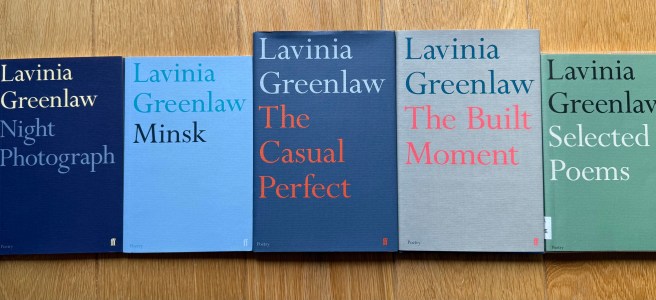
If a Selected Poems has an introductory note, it’s usually not very instructive, but Lavinia Greenlaw’s comments are genuinely interesting: ‘A poem is sudden and then it is slow. It continues to move between these two states while I try to keep up with its swerves or chip away at each impasse. When a poem … Continue reading ’wherever you get to is not far, still nowhere’
’If I don’t speak to/the darkness it/swallows me.’
At the beginning of October I was at the LRB bookshop for the launch of Sarah Howe’s new collection ‘Foretokens’. Towards the end a young woman at the front asked a really good question; it came from inexperience but was all the better for it. She said she’d only previously read the kind of poetry … Continue reading ’If I don’t speak to/the darkness it/swallows me.’
’an ancient, woven, wet, ditch-dance’
Elizabeth-Jane Burnett’s book ‘Twelve Words for Moss’ is not exactly a scientific book, although it contains a lot of botanical information. It’s more a series of meditations on moss and (trying to delay too-glib a rhyme) loss, specifically the loss of her father. Both nature writing and grief memoir, it is also interspersed with Burnett’s … Continue reading ’an ancient, woven, wet, ditch-dance’
’It persists as anomaly, as conscience, as critique and as refuge’
’It’s almost impossible to say why certain music attracts me, or interests me, and other things leave me cold. The process of criticism is heavily dependent on a rationalisation of subjectivity. As a critic, you can spend your life prioritising your own tastes with increasingly elaborate intellectual justifications that disallow any alternatives’. That’s David Toop, … Continue reading ’It persists as anomaly, as conscience, as critique and as refuge’
‘I am perfectly willing to appear ridiculous, absurd’: Roethke’s prose.
Having devoted the previous post to poets writing about Theodore Roethke, I found yet another poem. Richard Murphy’s ‘The Poet on the Island’ is dedicated to him:‘On a wet night, laden with books for luggage, And stumbling under the burden of himself, He reached the pier, looking for a refuge. ………………. Safety on water, he … Continue reading ‘I am perfectly willing to appear ridiculous, absurd’: Roethke’s prose.
Julian Orde, Theodore Roethke and serendipity
A story of serendipity; of poems that seem to talk to each other across decades. Two weeks ago I bought ‘Modern Poetry’ by Diane Seuss (lovely cover by Fitzcarraldo - the texture of it in the hand) and picked up ‘Conjurors’ by Julian Orde from the Greenwich Oxfam shop. With the Orde I must confess … Continue reading Julian Orde, Theodore Roethke and serendipity
‘Hours of Boredom’
‘What are people waiting for? What is the seed that they will endure hours of boredom to extract?’ That’s from Christopher Middleton’s ‘Jackdaw Jiving: Selected essays on poetry and translation’ (1998 - and I guess the compulsory reading of poetry must refer to the USA, none of that nonsense here..). I think I must be … Continue reading ‘Hours of Boredom’
George Barker ‘Like ice the winter ghosts and the white walls gleam and flare..’
Staying in Suffolk in early July, I came across ‘East Anglia: A Literary Pilgrimage’ by Peter Tolhurst. It’s full of the sort of literary anecdotes I tell myself I won’t waste time on, and then do. The key is the area’s close proximity to London for anyone who has business with magazines and publishers, yet … Continue reading George Barker ‘Like ice the winter ghosts and the white walls gleam and flare..’
‘The dancers are all gone under the hill’
Two weeks ago, in Somerset I made a visit to East Coker, the village where T.S.Eliot’s ashes are buried, and the title for the second of his Four Quartets. The church has a small display (see photo above) in a corner next to the memorial plaque for the poet and his second wife Valerie. Eliot … Continue reading ‘The dancers are all gone under the hill’
Poems from New Writing 1936-1946
It was an Islington Oxfam Bookshop buy; ‘Poems from New Writing 1936-1946’, selected by John Lehmann, with a front cover image by John Minton. New Writing was an anti-fascist magazine of the 30s (Lehmann also put together the anthology Poems for Spain) which became Penguin New Writing at the start of the war years. Lehmann, … Continue reading Poems from New Writing 1936-1946